Explore Accessories
Use these supporting guides to go deeper into specific questions, comparisons, and buying decisions.
- Oval Sunglasses: How to Choose the Right Pair
- Red Sunglasses: How to Choose the Right Pair
- Square Sunglasses: How to Choose Well
- Brown Sunglasses: How to Choose the Right Pair
- Escada Sunglasses: A Practical Buying Guide
- Gold Sunglasses: How to Choose the Right Pair
- Sunglasses in Black: A Buyer Guide
- Tortoise Shell Sunglasses: A Practical Buying Guide
- Acetate Sunglasses: What to Know Before You Buy
- Art the Clown Sunglasses Guide
- Non Polarized Sunglasses: When They Make Sense
- Red Lens Sunglasses: How to Choose
- Sunglasses With Blue: How to Choose
- Women’s Aviator Sunglasses: Buyer Guide
- Yellow Colour Sunglasses: A Practical Guide
- Best Aviator Sunglasses for Women
- Best Sunglasses for Fishing: A Smart Buyer’s Guide
- Best Sunglasses for Round Faces
- Western Leather Belts for Men: A Buying Guide
- Work Belts for Men: A Buying Guide
- Western Wallets for Men: Buyer’s Guide
- Engraved Wallets for Men: A Buyer’s Guide
- Woven Belts for Men: A Buying Guide
- Best Canvas Belts for Men: Buying Guide
- Suede Belts for Men: A Buyer’s Guide
- Bi-Fold Wallets for Men: How to Choose
- Cowboy Wallets for Men: A Practical Guide
- Leather Chain Wallets for Men: Buying Guide
- Unique Wallets for Men: A Buyer’s Guide
- Mens Travel Accessories Buying Guide
- Alligator Belts for Men: A Buying Guide
- Brown Belts for Men: Buyer’s Guide
- Dance Belts for Men: Buyer’s Guide
- Magnetic Belts for Men: A Practical Guide
- Military Style Belts for Men TSA Guide
- Custom Leather Wallets for Men: Buyer Guide
- Front Pocket Leather Wallets for Men Guide
- Handmade Leather Wallets for Men: Buyer Guide
- Hooey Wallets for Men: Buying Guide
- Rodeo Wallets for Men: Buying Guide
- Slim RFID Wallets for Men: What to Look For
- Brighton Belts for Men: A Smart Guide
- Tool Belts for Men: How to Choose
- Brown Leather Wallets for Men: A Buyer’s Guide
- Browning Wallets for Men: A Buying Guide
- Leather Wallets for Men Western
- Tactical Wallets for Men: Buyer Guide
- Engraved Wallets for Men: Buyer Guide
- Cool Travel Accessories for Guys
- Best Female Travel Accessories Guide
- Wide Belts for Men: How to Choose
- Best Front Pocket Wallets for Men
- Best Wallets for Men With Airtag
- Zip-Up Wallets for Men: What to Know
- Personalized Travel Accessories Guide
- Bally Belts for Men: Buyer’s Guide
- Best Work Belts for Men: Smart Buying Guide
- 3D Printed Travel Accessories Guide
- Luxury Leather Travel Accessories Guide
- Personalised Travel Accessories: A Practical Guide
- Best Travel Accessories for Gifts
- Beach Travel Accessories Guide for Easy Trips
- Best Trifold Wallets for Men: A Buyer’s Guide
- Best Bi-Fold Leather Wallets for Men
- Camo Wallets for Men: Buying Guide
- Cowboy Leather Wallets for Men: Buyer’s Guide
- Children’s Travel Accessories: A Practical Guide
- Luxury Dog Travel Accessories Guide
- Dog Car Travel Accessories Guide
- Leather Travel Accessories Buying Guide
- Buckleless Belts for Men: A Practical Guide
- Best Pet Travel Accessories: Buyer Guide
Quick answer: what black sunglasses do well
Black sunglasses are popular because they sit in a useful middle ground: they are neutral, easy to style, and available in nearly every frame shape. For many shoppers, the appeal is not just the color but the range of looks it supports, from understated and classic to sharp and fashion-forward.
If you are shopping for black sunglasses, the best choice usually comes down to four things: frame shape, fit, lens quality, and how often you plan to wear them. A pair that looks right but slips down your nose or feels too heavy will not stay in rotation for long. The best black sunglasses are the ones that match your face, your wardrobe, and your day-to-day use.
This guide breaks down the topic from a buyer’s perspective so you can compare options with more confidence before narrowing down to a specific style.
Why black sunglasses are such a reliable choice
Black frames have broad appeal because they are visually simple and flexible. They do not fight with color in the rest of your outfit, which makes them easier to wear across seasons and dress codes. That is one reason black sunglasses often show up in capsule wardrobes, travel bags, and everyday carry lists.
They also work across different style directions. A glossy black acetate frame can read polished and vintage-inspired, while a thin black metal frame feels lighter and more minimal. The same color can therefore support very different aesthetics, which makes the category larger than it first appears.
For many buyers, black sunglasses also offer a practical advantage: they are less trend-dependent than many bright or novelty finishes. That does not make them timeless in every design, but it does make the color itself easier to revisit over time.
Start with the frame style, not just the color
The biggest mistake shoppers make is focusing on black as the main decision and treating the frame shape as secondary. In reality, the silhouette determines most of the visual effect.
Common black sunglasses frame styles
- Wayfarer: A familiar, slightly angular shape that works well for everyday wear.
- Aviator: Typically thinner and more open around the lens area, with a classic, effortless feel.
- Square: Sharp lines that can add structure to softer facial features.
- Round: A softer, more retro look that suits some face shapes better than others.
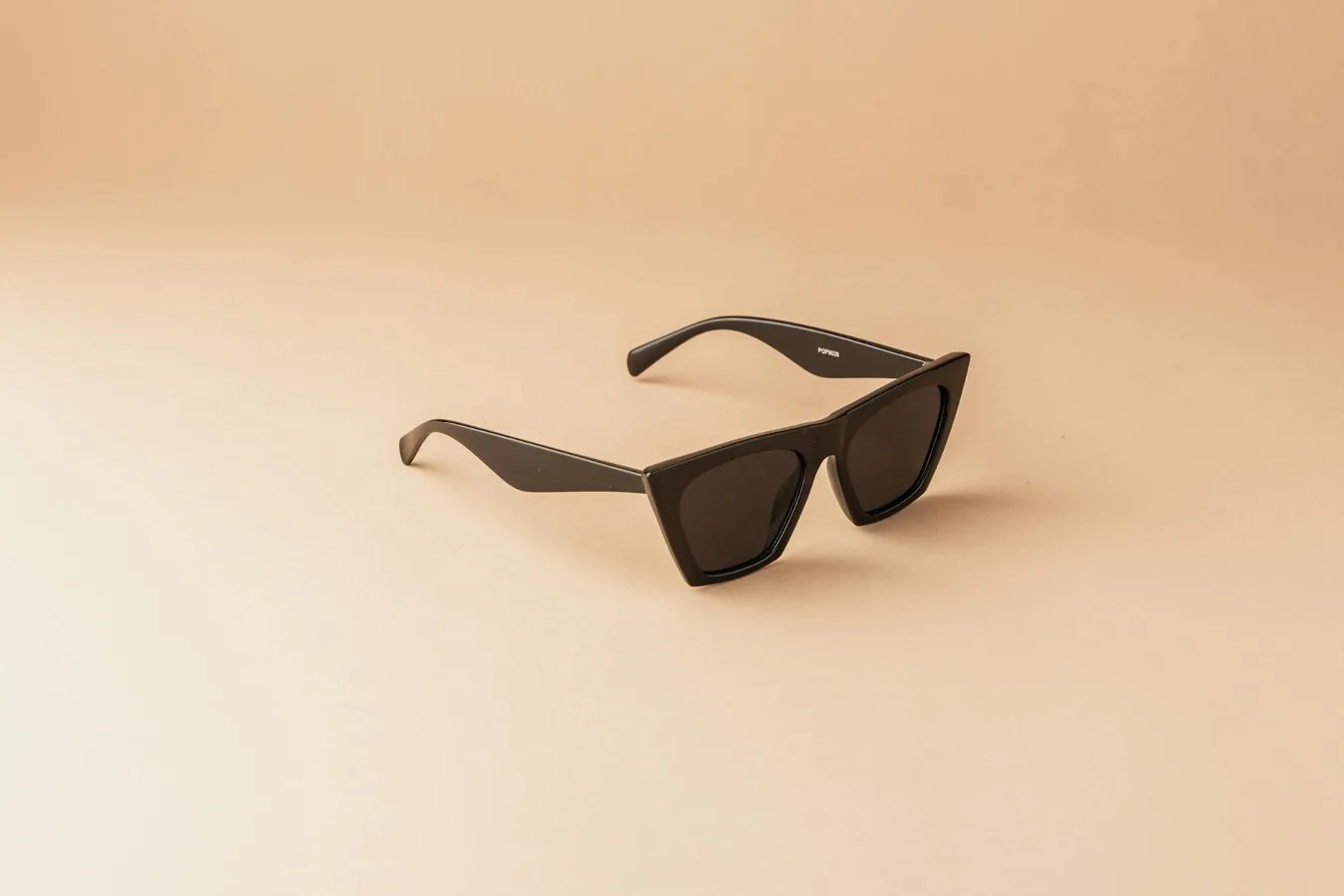
- Cat-eye: More lifted outer corners, often used for a refined or statement look.
- Oversized: Greater coverage and a more fashion-driven silhouette.
Each of these shapes can look completely different in black depending on thickness, finish, and proportions. A narrow black frame can feel understated, while a thick glossy one may become the focal point of an outfit.
How to compare black sunglasses without getting distracted
Because black is such a neutral color, comparison usually depends on the details that are easy to overlook. The following framework is often more useful than comparing style photos alone.
| Decision factor | Why it matters | What to look for |
|---|---|---|
| Frame shape | Affects face balance and overall style | Angular, round, cat-eye, or oversized silhouettes |
| Frame material | Influences weight, durability, and comfort | Acetate, plastic, metal, or mixed materials |
| Fit | Determines whether the sunglasses stay comfortable | Bridge fit, temple length, and lens width |
| Lens quality | Impacts clarity and protection | UV protection, polarization, tint consistency |
| Use case | Helps narrow choices by lifestyle | Everyday wear, travel, driving, fashion, outdoor use |
That framework is useful because it keeps the focus on how the sunglasses will actually perform in your life. A stylish frame that is awkward to wear is a poor value, even if it looks strong in photos.
Materials matter more than many shoppers expect
Black sunglasses can look similar across product listings, but the material changes the feel significantly. The most common choices are acetate, plastic, and metal, sometimes combined in hybrid designs.
Acetate
Acetate frames are often favored for their richer appearance and solid feel. They can be a good choice if you want a substantial black frame with more visual presence. They also tend to suit fashion-forward and classic silhouettes well.
Metal
Metal frames usually feel lighter and visually less bulky. Black metal sunglasses can be a smart option if you prefer a subtle profile or want something that looks less heavy on the face. They may not deliver the same bold presence as thick acetate, but that can be an advantage for some outfits.
Plastic and mixed materials
Many everyday sunglasses use plastic or blended constructions that balance weight and cost. The quality range is wide, so it helps to examine hinge feel, finish consistency, and how the frame sits at the bridge and temples.
Material choice also affects care. Glossy black frames may show fingerprints and scuffs more easily than matte finishes, while lighter constructions may feel comfortable but less sturdy depending on the build.
Fit is the difference between wearable and annoying
Fit is often the most practical part of the decision, yet it is the one many shoppers evaluate least carefully. Sunglasses that pinch, slide, or rest unevenly can become unusable, regardless of style.
Pay attention to the bridge area first. If the frame sits too low or slides forward, the sunglasses may not be right for your nose shape. Temple pressure matters too; if the arms are too tight, they can create discomfort behind the ears or on the sides of the head.
Lens width and overall frame proportion also affect how the sunglasses look. Large lenses can dominate a smaller face, while petite frames may appear lost on broader features. That does not mean one face shape can only wear one style, but proportion should be part of the decision.
If you are shopping online, check sizing details carefully and compare them to a pair you already wear comfortably. Those measurements are often more useful than generic style descriptions.
Lens choices: what matters for everyday use
Black frames can pair with many lens types, so the lens is a separate decision rather than a detail to ignore. The right lens depends on where and how you plan to wear the sunglasses.
UV protection
For daily wear, UV protection is one of the most important considerations. Sunglasses should do more than reduce brightness; they should help shield the eyes from ultraviolet light. This is especially relevant if you spend time outdoors regularly.
Polarized lenses
Polarized lenses can reduce reflected glare, which may be useful for driving, water activities, and bright outdoor environments. They are not automatically the best choice for everyone, though. Some users prefer non-polarized lenses for screens, certain work settings, or simply because they want a different visual experience.
Tint and darkness
Darker lenses do not necessarily mean better protection. The useful question is whether the lens offers the right level of comfort and visibility for your environment. Very dark tints may feel appropriate in strong sun, while a more moderate tint can be easier for mixed indoor-outdoor use.
For black sunglasses that will be worn often, lens clarity, consistency, and comfort under varying light conditions matter as much as appearance.
How black sunglasses fit different style needs
Because black is so adaptable, the same category can serve multiple style goals. That makes it a useful purchase for practical wardrobes, but it also means you should be clear about the role you want the sunglasses to play.
For everyday wear
For regular use, comfort and versatility should come before trendiness. A balanced frame with reliable fit and moderate lens coverage is usually the safest choice.
For a sharper fashion look
If the sunglasses are meant to function as a style statement, look at silhouette, thickness, and finish. Glossy black acetate, angular frames, and oversized shapes tend to read more fashion-forward.
For travel and commuting
Travel use often calls for durability, portability, and easy coordination. Black sunglasses are useful here because they can pair with multiple outfits and do not require much styling effort.
For driving
Driving-oriented pairs benefit from good glare control, comfortable coverage, and a fit that does not need constant adjustment. Lens choice becomes more important than trend-driven styling.
Black sunglasses and face shape: a practical way to think about it
Face shape guidance should be treated as a starting point, not a rulebook. The goal is to create balance, not to force a perfect match.
- Rounder faces often pair well with more angular or structured frames.
- Angular faces can be softened by rounder or more curved silhouettes.
- Longer faces may benefit from deeper frames or styles with more visual width.
- Smaller faces often need slimmer proportions and careful bridge sizing.
Black frames can amplify these effects because the color is visually strong. That makes proportion especially important. A thick black frame that looks balanced on one person may feel overpowering on another, even if both are drawn to the same style.
What to inspect before buying
Whether you are shopping in store or online, a few details can help you judge quality more reliably.
- Hinges: Open and close smoothly without feeling loose or uneven.
- Bridge fit: The frame should sit comfortably without constant sliding.
- Temple alignment: Arms should rest evenly and not press too hard.
- Lens finish: Look for even tint and a clean surface without distracting distortion.
- Frame symmetry: The sunglasses should look balanced from front and top angles.
- Overall weight: Heavy frames are not always a problem, but they should feel manageable for long wear.
These details do not require technical expertise. They simply help you avoid a pair that looks good in a photo but feels awkward in real use.
Common mistakes to avoid
Black sunglasses are easy to buy impulsively, which is why the same mistakes come up again and again.
Choosing by color alone
Black is versatile, but the frame shape does the real style work. If the silhouette is wrong, the color cannot fix it.
Ignoring bridge fit
Many fit problems start at the bridge. A frame that slides constantly can become frustrating even if everything else is right.
Overlooking lens use case
Not every lens type is equally useful for every activity. A pair that works well for fashion may not be ideal for driving or all-day outdoor wear.
Assuming darker lenses are better
Lens darkness is only one part of the experience. Protection, clarity, and comfort matter more than the shade of the tint alone.
Buying a style that does not fit your wardrobe
Black sunglasses should complement the clothes and accessories you actually wear. A highly dramatic frame can be fun, but only if it will leave the drawer often enough to justify the purchase.
Care and maintenance basics
Proper care helps black sunglasses keep their appearance longer, especially if the finish is glossy or the frame is used daily. Smudges, sunscreen residue, dust, and abrasion can all affect the look and feel of the frame over time.
- Store them in a case when not in use.
- Wipe lenses and frames gently with a clean microfiber cloth.
- Avoid rough surfaces that can scratch lenses or scuff the frame.
- Keep them away from heat that can warp certain materials.
- Rinse off grit before wiping if they have been exposed to sand or dust.
Care is especially important for black frames because scratches, wear marks, and finish changes can be more visible against a dark surface.
Comparing black sunglasses to other neutral options
Black is not the only versatile frame color, but it is among the most dependable. Compared with tortoiseshell, black usually feels cleaner and more graphic. Compared with brown or clear frames, it tends to create more contrast and stronger definition.
The right choice depends on the look you want to project. If you want eyewear to blend in, black is often the easiest route. If you want a softer or more textured look, other neutrals may feel more natural. That is one reason many shoppers eventually keep more than one pair for different outfits and settings.
How to think about value
Value in black sunglasses is not just about price. It is about how often the pair gets worn, how well it fits, and whether the design still feels relevant after the novelty fades.
A lower-cost pair can be the right move if you want a trend-driven shape or need a backup. A more thoughtfully built pair may make more sense if you expect heavy use and want better comfort or durability. The right value choice is the one that matches your actual habits, not just the lowest number on the page.
FAQ
Are black sunglasses good for everyday wear?
Yes. Black sunglasses are one of the easiest styles to wear daily because they pair well with most clothing colors and work in both casual and more polished settings.
What frame shape is most versatile in black?
Wayfarer-style and simple square frames are often the most versatile, but the best option depends on your face shape and personal style. A well-balanced shape usually matters more than trendiness.
Are polarized lenses worth it in black sunglasses?
They can be, especially for driving and bright outdoor use where glare is a problem. If you mostly want a fashion accessory, polarization may be useful but not essential.
How do I know if black sunglasses fit properly?
They should sit securely without pinching, sliding, or resting too low on your nose. The temples should feel even, and the frame should look balanced from the front.
Can black sunglasses work with formal outfits?
Yes, especially slimmer frames or cleaner silhouettes. A minimal black frame often looks more refined than a bulky or highly decorative one.
Final take
Black sunglasses endure because they solve more than one problem at once. They can add polish, reduce visual noise, and fit into a wide range of wardrobes. But the color alone does not make a good pair. Frame shape, fit, lens quality, and material choice are what decide whether the sunglasses stay useful beyond the first wear.
If you approach black sunglasses as a category rather than a single look, it becomes easier to choose well. Start with how you plan to wear them, then narrow by shape, comfort, and lens features. That method leads to better purchases and fewer regrets.